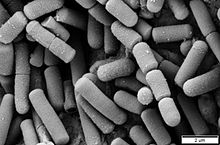
Bacillus cereus is a Gram-positive, rod-shaped, facultatively anaerobic, motile, beta-hemolytic, spore forming bacterium commonly found in soil and food. The specific name, cereus, meaning "waxy" in Latin, refers to the appearance of colonies grown on blood agar. Some strains are harmful to humans and cause foodborne illness, while other strains can be beneficial as probiotics for animals.[1][2] The bacteria is classically contracted from fried rice dishes that have been sitting at room temperature for hours.[3][4] B. cereus bacteria are facultative anaerobes, and like other members of the genus Bacillus, can produce protective endospores. Its virulence factors include cereolysin and phospholipase C.[citation needed]


The Bacillus cereus group comprises seven closely related species: B. cereus sensu stricto (referred to herein as B. cereus), B. anthracis, B. thuringiensis, B. mycoides, B. pseudomycoides, and B. cytotoxicus.[5]
Ecology
B. cereus competes with other microorganisms such as Salmonella and Campylobacter in the gut; its presence reduces the numbers of those microorganisms. In food animals such as chickens,[6] rabbits[7] and pigs,[8] some harmless strains of B. cereus are used as a probiotic feed additive to reduce Salmonella in the animals' intestines and cecum. This improves the animals' growth, as well as food safety for humans who eat them. B. cereus can parasitize codling moth larvae.[citation needed]
B. cereus and other members of Bacillus are not easily killed by alcohol; they have been known to colonize distilled liquors and alcohol-soaked swabs and pads in numbers sufficient to cause infection.[9][10]
Some strains of B. cereus produce cereins, bacteriocins active against different B. cereus strains or other Gram-positive bacteria.[11]
Reproduction
At 30 °C (86 °F), a population of B. cereus can double in as little as 20 minutes or as long as 3 hours, depending on the food product.[12]
Pathogenesis
B. cereus is responsible for a minority of foodborne illnesses (2–5%), causing severe nausea, vomiting, and diarrhea.[13] Bacillus foodborne illnesses occur due to survival of the bacterial endospores when infected food is not, or inadequately, cooked.[14] Cooking temperatures less than or equal to 100 °C (212 °F) allow some B. cereus spores to survive.[15] This problem is compounded when food is then improperly refrigerated, allowing the endospores to germinate.[16] Cooked foods not meant for either immediate consumption or rapid cooling and refrigeration should be kept at temperatures below 10 °C (50 °F) or above 50 °C (122 °F).[15] Germination and growth generally occur between 10 °C and 50 °C,[15] though some strains can grow at low temperatures.[17] Bacterial growth results in production of enterotoxins, one of which is highly resistant to heat and acids (pH levels between 2 and 11);[18] ingestion leads to two types of illness: diarrheal and emetic (vomiting) syndrome.[19]
- The diarrheal type is associated with a wide range of foods, has an 8-to-16-hour incubation time, and is associated with diarrhea and gastrointestinal pain. Also known as the 'long-incubation' form of B. cereus food poisoning, it might be difficult to differentiate from poisoning caused by Clostridium perfringens.[18] Enterotoxin can be inactivated after heating at 56 °C (133 °F) for 5 minutes, but whether its presence in food causes the symptom is unclear, since it degrades in stomach enzymes; its subsequent production by surviving B. cereus spores within the small intestine may be the cause of illness.[20]
- The 'emetic' form is commonly caused by rice cooked for a time and temperature insufficient to kill any spores present, then improperly refrigerated. It can produce a toxin, cereulide, which is not inactivated by later reheating. This form leads to nausea and vomiting 1–5 hours after consumption. Distinguishing from other short-term bacterial foodborne intoxications such as by Staphylococcus aureus can be difficult.[18] Emetic toxin can withstand 121 °C (250 °F) for 90 minutes.[20]
The diarrhetic syndromes observed in patients are thought to stem from the three toxins: hemolysin BL (Hbl), nonhemolytic enterotoxin (Nhe), and cytotoxin K (CytK).[21] The nhe/hbl/cytK genes are located on the chromosome of the bacteria. Transcription of these genes is controlled by PlcR. These genes occur in the taxonomically related B. thuringiensis and B. anthracis, as well. These enterotoxins are all produced in the small intestine of the host, thus thwarting digestion by host endogenous enzymes. The Hbl and Nhe toxins are pore-forming toxins closely related to ClyA of E. coli. The proteins exhibit a conformation known as a "beta-barrel" that can insert into cellular membranes due to a hydrophobic exterior, thus creating pores with hydrophilic interiors. The effect is loss of cellular membrane potential and eventually cell death. CytK is a pore-forming protein more related to other hemolysins.[citation needed]
The timing of the toxin production was previously thought to be possibly responsible for the two different courses of disease, but in fact the emetic syndrome is caused by a toxin, cereulide, found only in emetic strains and is not part of the "standard toolbox" of B. cereus. Cereulide is a cyclic polypeptide containing three repeats of four amino acids: d-oxy-Leu—d-Ala—l-oxy-Val—l-Val (similar to valinomycin produced by Streptomyces griseus) produced by nonribosomal peptide synthesis. Cereulide is believed to bind to 5-hydroxytryptamine 3 (5-HT3) serotonin receptors, activating them and leading to increased afferent vagus nerve stimulation.[22] It was shown independently by two research groups to be encoded on multiple plasmids: pCERE01[23] or pBCE4810.[24] Plasmid pBCE4810 shares homology with the B. anthracis virulence plasmid pXO1, which encodes the anthrax toxin. Periodontal isolates of B. cereus also possess distinct pXO1-like plasmids. Like most of cyclic peptides containing nonproteogenic amino acids, cereulide is resistant to heat, proteolysis, and acid conditions.[25]
B. cereus is also known to cause difficult-to-eradicate chronic skin infections, though less aggressive than necrotizing fasciitis. B. cereus can also cause keratitis.[26]
A case study was published in 2019 of a catheter-related bloodstream infection of B. cereus in a 91-year-old male previously being treated with hemodialysis via PermCath for end-stage renal disease.[27] He presented with chills, tachypnea, and high-grade fever, his white blood cell count and high-sensitivity C-reactive protein (CRP) were significantly elevated, and CT imaging revealed a thoracic aortic aneurysm. He was successfully treated for the aneurysm with intravenous vancomycin, oral fluoroquinolones, and PermCath removal.
Spore elimination
While B. cereus vegetative cells are killed during normal cooking, spores are more resistant. Viable spores in food can become vegetative cells in the intestines and produce a range of diarrheal enterotoxins, so elimination of spores is desirable. In wet heat, spores require more than 5 minutes at 121 °C (250 °F) at the coldest spot to be destroyed. In dry heat, 120 °C (248 °F) in a sterilizer for 1 hour works for rice, for instance.[28]
Diagnosis
In case of foodborne illness, the diagnosis of B. cereus can be confirmed by the isolation of more than 100,000 B. cereus organisms per gram from epidemiologically-implicated food, but such testing is often not done because the illness is relatively harmless and usually self-limiting.[29]
Identification
For the isolation and enumeration of B. cereus, there are two standardized methods by International Organization for Standardization (ISO): ISO 7931 and ISO 21871. Because of B. cereus' ability to produce lecithinase and its inability to ferment mannitol, there are some proper selective media for its isolation and identification such as mannitol-egg yolk-polymyxin (MYP) and polymyxin-pyruvate-egg yolk-mannitol-bromothymol blue agar (PEMBA). B. cereus colonies on MYP have a violet-red background and are surrounded by a zone of egg-yolk precipitate.[30]
Below is a list of differential techniques and results that can help to identify B. cereus from other bacteria and Bacillus species.[31]
- Anaerobic growth: Positive
- Voges Proskauer test: Positive
- Acid produced from
- d-glucose: Positive
- l-arabinose: Negative
- d-xylose: Negative
- d-mannitol: Negative
- Starch hydrolysis: Positive
- Nitrate reduction: Positive
- Degradation of tyrosine: Positive
- Growth at
- above 50 °C: Negative
- Use of citrate: Positive
The Central Public Health Laboratory in the United Kingdom tests for motility, hemolysis, rhizoid growth, susceptibility to γ-phage, and fermentation of ammonium salt-based glucose but no mannitol, arabinose, or xylose.[30]
Prognosis
Most emetic patients recover within 6 to 24 hours,[19] but in some cases, the toxin can be fatal via fulminant hepatic failure In 2014, 23 newborns in the UK receiving total parenteral nutrition contaminated with B. cereus developed septicaemia, with three of the infants later dying as a result of infection.[37][38]
Bacteriophage
Bacteria of the B. cereus group are infected by bacteriophages belonging to the family Tectiviridae. This family includes tailless phages that have a lipid membrane or vesicle beneath the icosahedral protein shell and that are formed of approximately equal amounts of virus-encoded proteins and lipids derived from the host cell's plasma membrane. Upon infection, the lipid membrane becomes a tail-like structure used in genome delivery. The genome is composed of about 15-kilobase, linear, double-stranded DNA (dsDNA) with long, inverted terminal-repeat sequences (100 base pairs). GIL01, Bam35, GIL16, AP50, and Wip1 are examples of temperate tectiviruses infecting the B. cereus group.
| This article uses material from the Wikipedia article Metasyntactic variable, which is released under the Creative Commons Attribution-ShareAlike 3.0 Unported License. |