Anaplasma is a genus of bacteria of the alphaproteobacterial order Rickettsiales, family Anaplasmataceae.
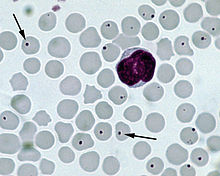
Anaplasma species reside in host blood cells and lead to the disease anaplasmosis. The disease most commonly occurs in areas where competent tick vectors are indigenous, including tropical and semitropical areas of the world for intraerythrocytic Anaplasma spp.[2]
Anaplasma species are biologically transmitted by Ixodes deer-tick vectors, and the prototypical species, A. marginale, can be mechanically transmitted by biting flies and iatrogenically with blood-contaminated instruments.[2] One of the major consequences of infection by bovine red blood cells by A. marginale is the development of nonhaemolytic anaemia, thus the absence of hemoglobinurea, which allows clinical differentiation from another major tick-borne disease, bovine babesiosis, caused by Babesia bigemina.[2]
Species of veterinary interest include:
- Anaplasma marginale and Anaplasma centrale in cattle
- Anaplasma ovis and Anaplasma mesaeterum in sheep and goats[2]
- Anaplasma phagocytophilum in dogs, cats, and horses (see human granulocytic anaplasmosis)
- Anaplasma platys in dogs
Genomes
The genomes from at least three different Anaplasma species have been sequenced.[3] These genomes are about 1.1 to 1.2 MB in size and encode 925 to 1,335 proteins.
| This article uses material from the Wikipedia article Metasyntactic variable, which is released under the Creative Commons Attribution-ShareAlike 3.0 Unported License. |